The Tariff War That Even the Supreme Court Couldn't Stop: Trump's Trade Act Section 122, 15% Tariff, and Korea's 150-Day Export Clock
Immediately after the U.S. Supreme Court ruled IEEPA mutual tariffs unconstitutional, Trump invoked Section 122 of the Trade Act of 1974 to raise global tariffs from 10% to 15% once again. We analyze the impact on Korea's key export sectors including semiconductors and automobiles, and what the 150-day deadline means.
Why you need to read this now: The U.S. Supreme Court blocked the IEEPA tariffs, but Trump reinstated a 15% tariff just one day later under a different legal provision — Section 122 of the Trade Act. For Korea, this is not a 'moment of relief' but 'deeper uncertainty.'
TL;DR
- February 20, 2026: The U.S. Supreme Court ruled 6:3 that IEEPA-based mutual tariffs were illegal
- Trump signed an executive order that same day invoking Section 122 of the Trade Act to impose a global 10% tariff
- One day later, he announced an increase to 15%, with some goods seeing the 15% rate take effect starting February 26
- Semiconductors and pharmaceuticals are under ongoing product-specific tariff negotiations → April is the real turning point
- Section 122 is a 150-day temporary provision — what comes after is even more uncertain
What Happened
On February 20, 2026, the U.S. Supreme Court ruled 6-3 that the 'mutual tariffs' imposed by the Trump administration under IEEPA (the International Emergency Economic Powers Act) exceeded presidential authority. Those tariffs were the sweeping import duties declared on 'Liberation Day' in April 2025, which had imposed a minimum of 10–25% on nearly all trading partners, including South Korea.
But markets had little time to breathe. President Trump immediately signed an executive order invoking Section 122 of the Trade Act of 1974 to impose a 10% tariff on all imports worldwide. Then just one day later, on February 22, he announced an increase to 15%, with some goods beginning to see that rate applied from February 26.
Why It Became a Trend — The Spread Mechanism
- The dramatic 'Supreme Court vs. President' storyline: A new tariff being enacted the very day after a SCOTUS ruling was a whiplash reversal that dominated global media.
- Korea's unique export vulnerability: As of early February 2026, Korea's exports to the U.S. had surged 47% year-on-year, with semiconductors alone up 134%. The tariff risk directly threatens to undermine export momentum.
- The unfamiliarity of 'Section 122': Most Koreans had barely heard of IEEPA, and the appearance of yet another legal provision within a single day spread a mix of exhaustion and anxiety — 'just how far will this go?'
Context and Background
What Is Section 122 of the Trade Act?
Section 122 of the Trade Act allows the U.S. president, when faced with a serious balance-of-payments deficit, to impose an import surcharge of up to 15% for a maximum of 150 days without congressional approval. It had been a 'sleeping law' never actually invoked since 1974. The two key constraints are:
- Rate ceiling: 15% (already at the maximum)
- Duration ceiling: 150 days (expiring around late July 2026)
The prevailing analysis is that Trump reached for this provision after IEEPA was blocked, exploiting the absence of any judicial precedent for interpreting it.
Status of Korea's Key Export Sectors
| Sector | Current Tariff | Notes |
|---|---|---|
| Semiconductors | Under negotiation (provisional exemption) | April product-specific tariff investigation results are the key variable |
| Automobiles | 25% (Section 232) | 25% was already in effect before Section 122 |
| Steel | 50% (Section 232) | Separate product-specific tariff maintained |
| General exports | 15% (Section 122) | Partial relief compared to IEEPA's 25% |
For semiconductors, the U.S. is conducting a separate product-specific tariff investigation under Section 232, making the April announcement the real watershed moment. The USTR previously signaled that 'existing agreements remain valid,' but nothing has been confirmed.
Outlook — What Comes After 150 Days Is Even Scarier
The Section 122 tariff is a 150-day temporary provision. When it expires at the end of July, Trump will have three paths:
- Request a congressional extension → Requires 60 Senate votes; passage is uncertain
- Replace with product-specific tariffs under Section 232 or 301 → Can target key sectors like semiconductors, automobiles, and pharmaceuticals directly
- Withdraw through a negotiated deal → A realistic option if Korea and other major trading partners offer investment and procurement packages
Experts cite 'a product-specific tariff bomb via Section 301 after Section 122 expires' as the most worrying scenario. Trump has in fact mentioned the possibility of applying Section 301 (unfair trade practices) investigations to South Korea as well.
Secondary Issues — Downstream Debates
- Exchange rate: The won/dollar rate remaining elevated due to tariff shocks → structural shift diminishing expectations of an 'export windfall effect'
- Samsung & SK Hynix: SK Hynix announced an additional ₩31 trillion investment in its Yongin fab, which could be used as a bargaining chip in U.S. investment negotiations
- Korean government stance: On February 21, the government stated that 'U.S. investment plans remain on schedule,' maintaining a dialogue posture amid uncertainty
- Global supply chain restructuring: If the 15% tariff persists beyond 150 days, discussions about rerouting exports through Vietnam and Mexico will reignite
Checklist — Key Dates to Watch
Reference Links
- Trump declares global tariff hike from 10% to 15% — BBC Korea
- Key question: maintaining zero tariffs on Korea's top export, semiconductors — Maeil Business
- Trump's 15% tariff rampage… Is Korea a target for Section 301 investigation? — YTN
- Trade policy outlook after U.S. IEEPA tariff ruling — thecodit
- Section 122 Tariff — White House Fact Sheet
- New US Tariffs, Same Problems for Korea — The Diplomat
Image Credit
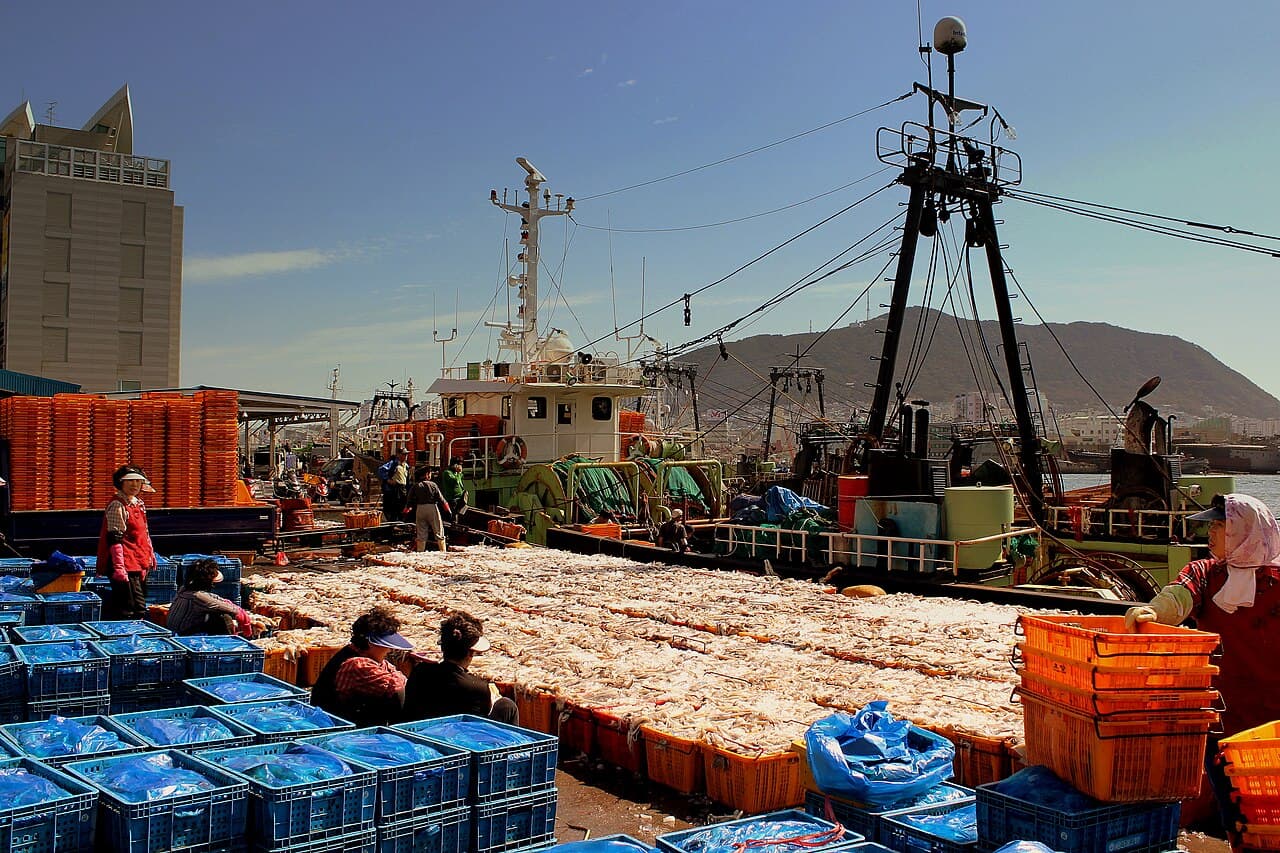
- Port of Busan: Wikimedia Commons (Public Domain)