Why Don't I Feel It When KOSPI Is at 6,300? The 5 Fractures of 'K-Shaped Growth' Warned by the Bank of Korea
Korea's KOSPI broke 6,000 for the first time in history, recording the world's top gain, but the Bank of Korea officially warned of 'K-shaped polarization' — where semiconductor/IT-concentrated growth weakens the ripple effects on consumption and prices. Excluding IT manufacturing, real growth is estimated at only the low-to-mid 1% range.
Why you need to read this now: In the age of KOSPI 6,300, brokerage app alerts trumpet new all-time highs every day — yet convenience store sales are falling and self-employed business closures are rising. The Bank of Korea has officially identified the structural cause of this disconnect.
TL;DR
- KOSPI surged 44%+ in 2026, breaching 6,000 for the first time on February 25 (currently at 6,300s as of February 27)
- The rally was driven by just two semiconductor stocks — Samsung Electronics and SK Hynix — which account for half of the total market cap gain
- Bank of Korea official statement: Excluding IT manufacturing, 2026 growth is only 1% range (low-to-mid)
- The wage and consumption spillover from the semiconductor boom is limited compared to the broader economy → The 'growth → inflation' formula is weakening
- Domestic demand slump and self-employed business distress continue; the asset gap based on financial asset ownership is widening rapidly
The Facts: KOSPI Rally by the Numbers
KOSPI crossed the 5,000 mark on January 22, 2026, and breached 6,000 just one month later on February 25. Bloomberg characterized this as "a breakthrough driven by the memory boom," with a cumulative 2026 gain of 44% — the highest among all major global indices. Nomura forecasts 8,000 and JPMorgan 7,500 by year-end.
However, the rally is being propped up by an extremely small number of stocks. Samsung Electronics, SK Hynix, and Hyundai Motor account for half of the increase in KOSPI's total market cap this year. SK Hynix's HBM (High Bandwidth Memory) demand has exploded to the point where operating profit projections range from ₩47 trillion in 2025 to as high as ₩145–175 trillion in 2026.
The Transmission Mechanism: Why a Stock Market Boom Coexists with a 'Felt Recession'
The Bank of Korea's report 'The Impact of Sectoral Growth Divergence on Prices', published on February 27, explains the structure of this contradiction.
Semiconductors are a highly automated, capital-intensive industry. Even as export performance explodes, the speed at which employment and wage gains spread to the service sector and domestic industries is slow. This structural limitation is the root of K-shaped polarization.
Context & Background: What Is K-Shaped Growth?
'K-shaped growth (K-shaped recovery)' is a phenomenon where the economic recovery curve splits — like the letter K — into groups that simultaneously trend upward and downward.
| Category | Upward (↑) | Downward (↓) |
|---|---|---|
| Industry | Semiconductors, AI, export conglomerates | Self-employed, domestic services, mid-size manufacturers |
| Assets | Stock and real estate holders | Those without financial assets |
| Wages | IT and high-skilled workers | Low-skilled and service workers |
President Lee Jae-myung officially acknowledged in his New Year's address on January 9 that Korea "faces the critical challenge of K-shaped growth." Bank of Korea Governor Lee Chang-yong has also repeatedly stated that "the continuation of K-shaped recovery is concerning."
This is not an isolated phenomenon in the global context either. In the United States, the top 10% of income earners account for 50% of all consumption — an extreme concentration of spending. ING forecasts that Korea's K-shaped recovery will persist until 2027.
Outlook: KOSPI 8,000 vs. Domestic Demand Slump — Which Comes First?
There are broadly two scenarios.
Scenario A — Optimistic (Virtuous Cycle Achieved)
- Expanding AI investment demand → Semiconductor super-cycle continues through 2028
- Rising corporate profits → Wage increases → Expansion of service consumption
- 3rd Commercial Act amendment (mandatory treasury share cancellation) strengthens shareholder returns → Increased consumption capacity
Scenario B — Pessimistic (Polarization Entrenched)
- Semiconductor cycle peaks and falls sharply → Failure to replace growth engine
- Weak domestic demand base leaves economy fragile → Permanent gap between the asset-rich and asset-poor
- Liquidity flowing into CMA and investment deposit accounts → Asset market concentration instead of real investment
ING forecasts the Bank of Korea will not resume rate hikes until 2027, and that the K-shaped imbalance will serve as a constraint on monetary policy until then.
Checklist: 5 Things Investors, Workers, and Policymakers Should Watch
References
- Korea JoongAng Daily — Kospi topping 6,000 masks K-shaped divide (2026.02.27)
- Hankyoreh — The K-shaped cloud hanging over Korea's economy
- Bloomberg — Memory Boom Drives Korean Stocks' Breakthrough Past 6,000 (2026.02.25)
- Reuters — South Korea's KOSPI stock index tops 6,000 for first time (2026.02.25)
- ING Think — Why South Korea is staging a K-shaped economic recovery
Image Credits
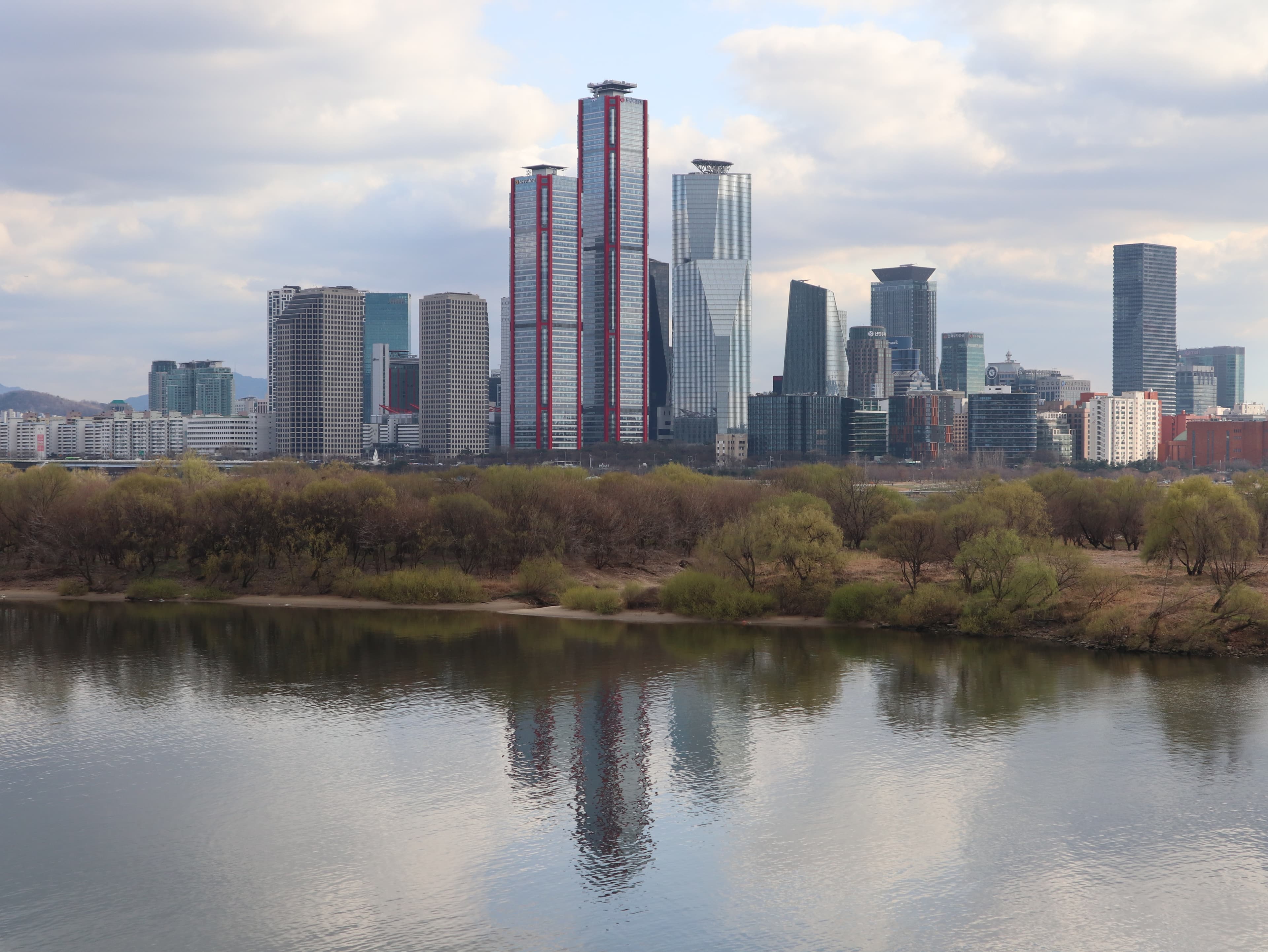
- Seoul Yeouido Financial District: Wikimedia Commons, CC BY 4.0 (S h y numis, 2024)