Is It a ₩9 Trillion Gamble or the Blueprint of a Future City? 5 Reasons Hyundai Motor Group's Saemangeum AI·Robot·Hydrogen Investment Will Reshape Korea's Industrial Landscape
Hyundai Motor Group signed an agreement on February 27, 2026, to invest ₩9 trillion (approximately $6.3 billion) in Saemangeum, North Jeolla Province, to develop an AI data center, robot factory, and hydrogen plant. With an expected 70,000 jobs and ₩16 trillion in economic impact, this marks the formal beginning of Korea's manufacturing industry's 'Physical AI' transformation.
TL;DR
- ₩9 trillion (approx. $6.3 billion) investment: AI data center ₩5.8T, robot factory ₩400B, electrolysis (hydrogen) plant ₩1T, solar ₩1.3T
- 50,000 GPU AI data center — dedicated to autonomous driving and robot training
- Korea's first dedicated robot finished-goods factory and parts cluster established simultaneously
- Projected job creation of 70,000, economic ripple effect of ₩16 trillion
- President Lee Jae-myung attended the signing ceremony: "Will completely transform the economic map of the Honam region"
1. What Happened — The Facts
On the morning of February 27, 2026, the 'Saemangeum Robot·Hydrogen·AI City Investment Signing Ceremony' was held at Saemangeum Convention Center in Gunsan, North Jeolla Province. This agreement — signed by Hyundai Motor Group along with the Ministry of Trade, Industry and Energy; Ministry of Climate, Energy and Environment; North Jeolla Special Self-Governing Province; and the Saemangeum Development Agency — covers the construction of the following facilities on a site of 1,124,000㎡ (approximately 340,000 pyeong).
| Investment Item | Amount | Key Details |
|---|---|---|
| AI Data Center | ₩5.8 trillion | 50,000 GPUs, dedicated to autonomous driving and robot training |
| Robot Finished-Goods Factory & Parts Cluster | ₩400 billion | Korea's first dedicated robot manufacturing facility |
| Electrolysis Plant (Hydrogen Production) | ₩1 trillion | Electrolyzing water to produce green hydrogen |
| Solar Power Generation Facility | ₩1.3 trillion | Targeting energy self-sufficiency for AI and robot facilities |
| Other (AI Hydrogen City Infrastructure, etc.) | Approx. ₩500 billion | Smart city infrastructure |
This investment is part of Hyundai Motor Group's ₩125.2 trillion domestic investment plan for 2026–2030, announced in November 2025.
2. Why Saemangeum? — The Diffusion Mechanism
Land Cost and Regulatory Benefits
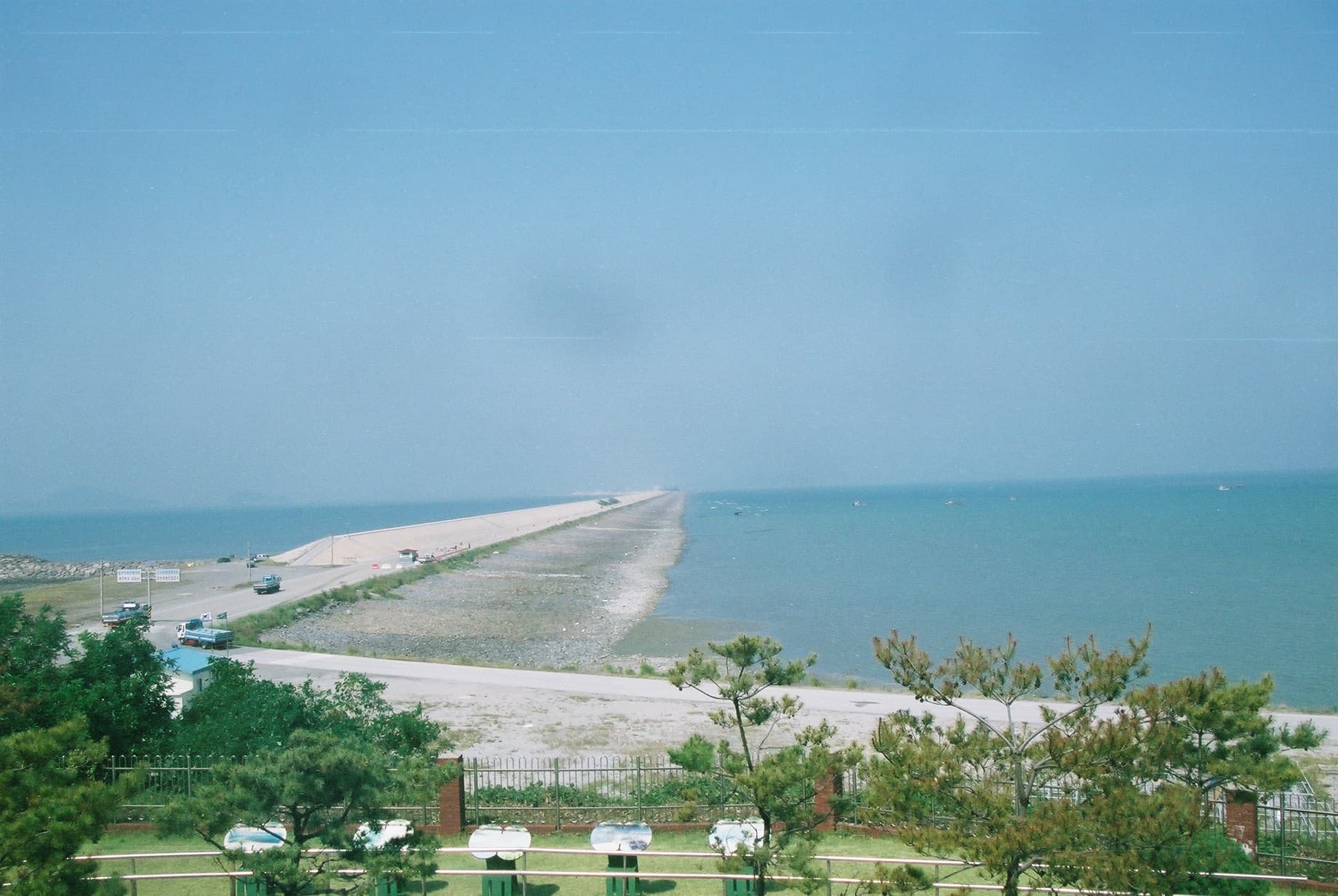
Saemangeum is a site created through the world's largest reclamation project, ongoing since 1991. Located approximately 270km southwest of Seoul, it offers the decisive advantage of securing large plots of land at low cost. The Saemangeum Development Agency's one-stop licensing and permitting support is also attractive from a corporate perspective.
Conditions for Physical AI
The key is that the AI data center and robot factory are on a single site. The moment robots are produced, they can receive real-time training and updates from the data center, and feed back to the factory — enabling Closed Loop AI manufacturing. This is the proving ground for the 'Physical AI' strategy that Hyundai Motor Group aims for.
Hydrogen Self-Sufficiency Structure
Power is generated by solar (₩1.3T), and green hydrogen is produced via electrolysis equipment (₩1T) to supply the factory and data center — an energy self-sufficient industrial complex model. A structure that simultaneously satisfies carbon neutrality goals and ESG requirements.
3. Stakeholder Analysis
- Hyundai Motor Group: Staking a claim in 'Physical AI' competing with Tesla Optimus and Boston Dynamics — already holds Boston Dynamics (acquired 2021) and Hyundai Robotics
- Lee Jae-myung Administration: Visible results of the AX (AI Transformation) policy — simultaneously achieving regional balanced development (Honam) and fostering advanced industries
- North Jeolla Special Self-Governing Province: Expected 70,000 jobs in the Gunsan/Saemangeum area — largest-scale investment since the shipbuilding industry downturn
- Global AI Chip Supply Chain: Demand for 50,000 GPUs — expected increase in demand for Nvidia and SK Hynix HBM
- Competitors (Tesla·Amazon·MS): A signal that a Korean company is securing its own independent infrastructure in the global AI infrastructure competition
4. Sustainability Outlook — How Long Will It Last?
This investment is not a one-time windfall. For three reasons, it is highly likely to become entrenched as a long-term trend.
- The Global Physical AI War: Competition among Tesla Optimus, Amazon industrial robots, and Boston Dynamics (Hyundai affiliate) is rapidly accelerating from 2026–2030
- Korean Government's AX Transformation Drive: President Lee Jae-myung is expected to demand the 'Saemangeum model' from other companies as well
- Hydrogen Economy Timeline: Aligned with the 2030 target timeline for green hydrogen price competitiveness
5. Risk Checklist
Reference Links
- Reuters: Hyundai Motor Group to invest $6.3 bln in AI data centre, robot factory
- Bloomberg: Hyundai Motor to Invest $6.3 Billion in AI, Robotics Center
- Yonhap News: Hyundai Motor to invest 9 tln won in Saemangeum for AI, hydrogen mobility
- Korea JoongAng Daily: Hyundai directs $6.3B to Saemangeum for first robot plant, data center
- Hankyung: President Lee Jae-myung's remarks on Hyundai Motor's Saemangeum AI·Robot investment
Image Source: Saemangeum Seawall, Wikimedia Commons, CC BY-SA 3.0