Where Does 44% End? The Complete Guide to 'KOSPI 7000 Bulls' vs 'Correction Warning' the Day After KOSPI Breaks 6,000
The KOSPI surged 44.4% year-to-date to become the world's top-performing major market, breaking the 6,000 mark for the first time in history. As major brokerages — Hana Securities (7,870), Hyundai Motor Securities, NH Investment, Kiwoom, and Korea Investment (7,000+) — all raised their targets, warnings of 'large-cap concentration' and 'leveraged trading overheating' are being raised simultaneously, dividing investor sentiment.
Why should you read this right now? The day after KOSPI broke 6,000, the brokerage community is already talking about 7,000. Yet six out of ten stocks remain left out of the celebration. Here we lay out the key variables that determine whether this rally can continue — or whether it's an overheating that calls for caution.
TL;DR
- KOSPI is up 44.4% in 2026, the undisputed #1 among major global markets
- Closing at 6,083.86 on Feb 25, it broke the 6,000 mark for the first time in history
- Major brokerage targets: Hana Securities 7,870 / Hyundai Motor, NH, Kiwoom, Korea Investment: 7,000+
- However, KOSDAQ saw 659 advancing stocks vs 1,014 declining stocks — large-cap concentration is pronounced
- Margin debt balance is rising, and overheating warnings are being issued simultaneously
The Facts: What Happened When KOSPI Broke 6,000
On Wednesday, February 25, 2026, the KOSPI closed at 6,083.86, up 1.91% from the previous session. This marked the first time in history the index crossed the 6,000 threshold. The rally was led by Hyundai Motor and Kia (automotive) and Samsung Electronics and SK Hynix (semiconductors).
The year-to-date gain of 44.37% is overwhelmingly higher than Japan's Nikkei (lower than the start of the year despite hitting an all-time high) and the U.S. S&P 500. Last year, the KOSPI already ranked #1 among G20 markets with a return of 75.63%.
The number of brokerage accounts surpassed 100 million, reflecting the intense participation of retail investors (known as 'ants'), and by market capitalization the KOSPI has risen to approximately 9th in the world.
Drivers: Why Did It Rise So Quickly?
1. AI Semiconductor Super-Cycle
SK Hynix's board resolution (Feb 25) to commit an additional ₩31 trillion to its Yongin fab, along with a surge in Samsung Electronics' HBM shipments, propelled the semiconductor sector. Macquarie shocked the market right after the 6,000 breakthrough by sharply raising its price targets for Samsung Electronics and SK Hynix.
2. Acceleration of Shareholder Return Legislation
The passage of the 3rd Commercial Act Amendment (mandatory treasury share cancellation) at the plenary session on Feb 25 institutionally strengthened shareholder return policies for listed companies. Listed companies' net profit forecasts were also revised up 59.5% compared to year-end.
3. Policy and Regulatory Reform Expectations
President Lee Jae-myung's commitment to resolving the 'Korea Discount' has continued to drive foreign capital inflows. Since the start of the year, foreigners have made net purchases of tens of trillions of won on the KOSPI.
The Case for KOSPI 7,000
| Brokerage | KOSPI Target | Core Argument |
|---|---|---|
| Hana Securities | 7,870 | Listed company earnings growth rate up 80%+ |
| Hyundai Motor Securities | 7,000+ | Semiconductor super-cycle continues |
| NH Investment Securities | 7,000+ | Foreign fund flow improvement |
| Kiwoom Securities | 7,000+ | Institutionalized shareholder return effect |
| Korea Investment Securities | 7,000+ | Low PBR resolution momentum |
Key condition: Sustained strong growth of semiconductor leaders such as Samsung Electronics and SK Hynix + continued global AI investment.
The Case for Caution
Context: Why Is Korea's Market So Uniquely Strong?
The 'Korea Premium' phenomenon, which intensified from the second half of 2025, has three structural drivers:
- Policy shift: The Lee Jae-myung government's Commercial Act reform and mandatory shareholder returns
- Earnings surprise: AI demand surge caused semiconductor companies' profits to far exceed forecasts
- Money movement: Capital flowing from real estate → equities in a low interest rate environment
Outlook and Checklist
Conditions Checklist for Reaching 7,000
What Investors Should Check Right Now
- Margin debt ratio: Excessive individual leverage amplifies declines during corrections
- Whether foreign net buying continues: Signs of outflows are a leading correction indicator
- Semiconductor industry indicators: AI server DRAM demand monitoring
Secondary Issues and Derivative Points
- KOSPI market cap at world #9 — Entry into the top 10 could increase weighting in global passive funds (ETFs)
- Pension reform and the stock market: Discussions on increasing the National Pension Fund's equity allocation could add further supply-demand support
- Exchange rate variable: Won strength may pressure export company earnings vs. easing foreign investors' FX gain burden
Reference Links
- KOSPI's 44% YTD gain leads the world... 'Heading to 7,000' vs 'Brace for a fall' — Donga Ilbo (2026.02.26)
- Major brokerages remain optimistic — Chosun Ilbo (2026.02.26)
- 'Above 6,000, but only Samsung and SK Hynix are smiling?' — Chosun Biz (2026.02.26)
- The unprecedented '6,000 era'... Now let's build a different market — Yonhap News (2026.02.25)
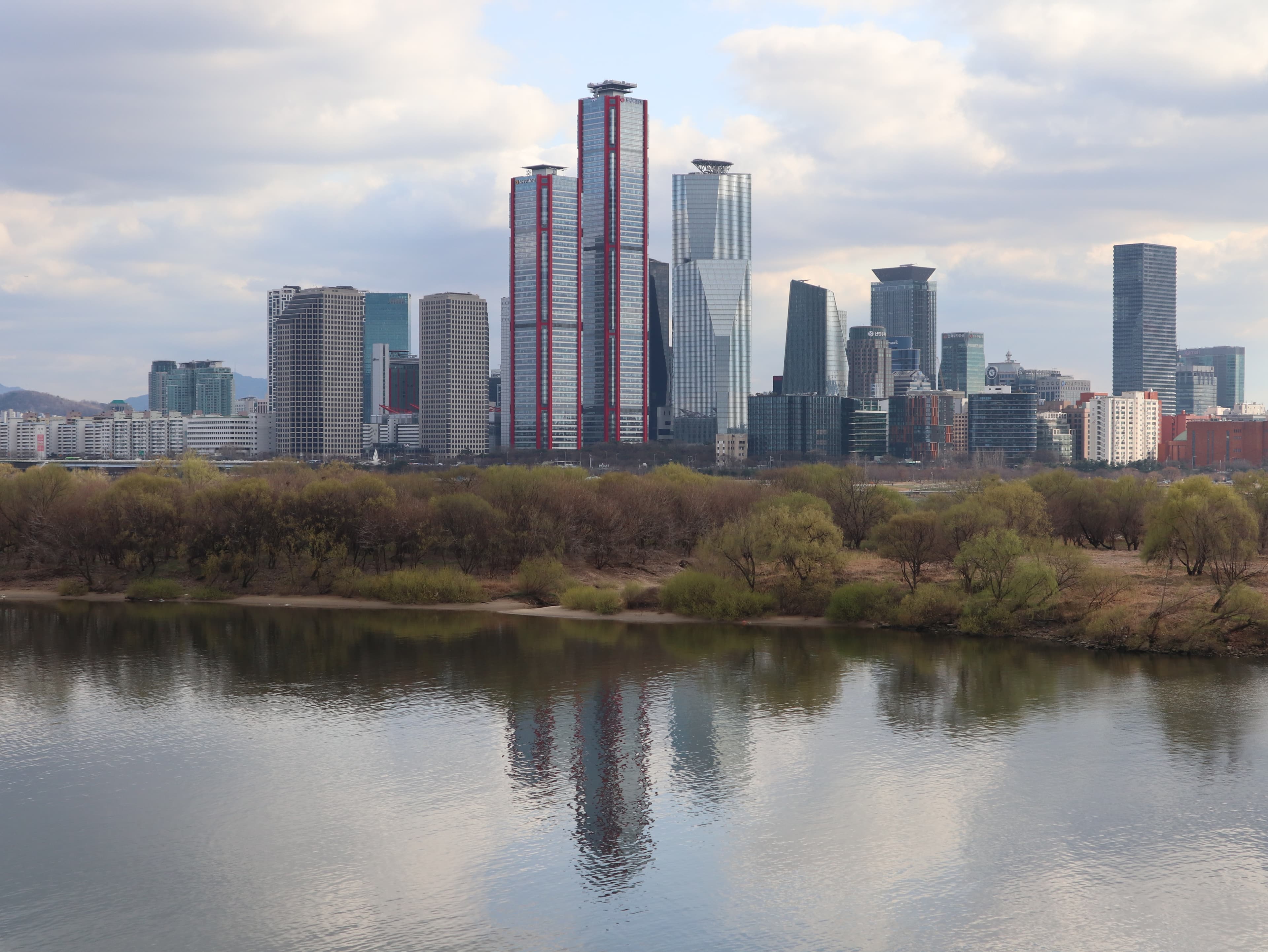
Image source: Wikimedia Commons (Skyline of Yeouido, a prominent finance district in Seoul, CC BY 4.0, S h y numis, 2024)