More Dangerous After the Ruling: Why Hyundai Motor Warned of 'Escalating Tariff Pressure' and the Truth Behind ₩7.2 Trillion
Immediately after the U.S. Supreme Court ruled Trump's IEEPA reciprocal tariffs illegal, Hyundai Motor Group President Sung Kim warned that 'sectoral tariff pressure on industries like automobiles could actually intensify.' With Hyundai and Kia already hit by ₩7.2 trillion in tariff damage last year, delays in the Korean National Assembly's passage of the Special Act on Investment in the U.S. have emerged as a critical new variable.
Why you need to read this now: The U.S. Supreme Court put the brakes on Trump's tariffs — so why is Hyundai Motor more worried than ever? Understanding the paradox reveals the full scope of Korea's manufacturing risks in 2026.
TL;DR
- Hyundai Motor Group President Sung Kim warned at a National Assembly breakfast meeting on February 24 that "following the IEEPA ruling, pressure for sectoral tariff hikes on automobiles and other industries could actually increase"
- Hyundai and Kia suffered a combined financial blow of ₩7.2 trillion (approximately $4.98 billion) from U.S. tariffs in 2025
- Delays in the Korean National Assembly's passage of the Special Act on Investment in the U.S. (implementing a $350 billion investment package) could provide grounds for a re-escalation to 25% tariffs
- Section 232 tariffs (sectoral tariffs on automobiles and steel on national security grounds) remain unaffected by the IEEPA illegality ruling — the real blade is still raised
The Facts: What Happened at the National Assembly on February 24
On February 24, 2026, Hyundai Motor Group President Sung Kim attended the 'Economic Sector Breakfast Meeting on the Special Act on Investment in the U.S.' held at the National Assembly in Seoul. With People Power Party lawmakers and key business leaders in attendance, Sung Kim delivered an unexpected message.
Four days earlier (February 20), the U.S. Supreme Court had ruled Trump's IEEPA (International Emergency Economic Powers Act)-based reciprocal tariffs illegal. Korean exporters were breathing a collective sigh of relief. Yet Sung Kim's remarks ran in the opposite direction.
"As the reciprocal tariffs have been invalidated, pressure for sectoral tariff hikes targeting specific industries such as automobiles could actually intensify."
Why did this paradoxical warning emerge?
The Escalation Mechanism: Why the 'Illegal Ruling' Is Actually More Dangerous
The Structural Trap: IEEPA vs. Section 232
What the Supreme Court ruling invalidated is solely the reciprocal tariffs based on IEEPA. In contrast, Section 232 tariffs (sectoral tariffs justified on national security grounds), which apply directly to the automotive and steel industries, rest on an entirely different legal foundation and are unaffected by this ruling.
Korean automobiles currently face a 15% tariff (reduced from 25% to 15% under a Korea-U.S. agreement last November). However, President Trump has threatened to re-escalate back to 25%, citing delays in the Korean National Assembly's passage of the Special Act on Investment in the U.S.
The Logic of the Paradox
With IEEPA reciprocal tariffs now blocked, the Trump administration has gained incentive to more aggressively deploy the remaining tools (Sections 232 and 301) to achieve its objectives. Sung Kim's warning emerged in precisely this context.
Context and Background: What ₩7.2 Trillion Tells Us
Damage Already Underway
| Metric | Figure |
|---|---|
| Financial impact of 2025 U.S. tariffs | ₩7.2 trillion (Hyundai + Kia combined) |
| Hyundai Motor standalone tariff damage | Approx. ₩4.1 trillion |
| Hyundai Motor 2025 operating profit decline | Approx. -20% |
| Q4 standalone tariff burden | ₩1.5 trillion |
| Scale of U.S. investment package | $350 billion (approx. ₩505 trillion) |
| Current automobile tariff rate | 15% (Korea-U.S. agreement; 25% threatened) |
Hyundai Motor's 2025 operating profit hit its lowest level in three years. Despite record-high revenue, tariff burdens eroded profits — a stark illustration of the stakes.
The Special Act on Investment in the U.S. as the Key Variable
The trade agreement with the Trump administration includes a package of $350 billion in U.S. investments by Korean companies. Implementing this package requires passage of the Special Act on Investment in the U.S. through the Korean National Assembly.
Yet the bill has stalled in the legislature. Trump has been using this delay as a pretext to threaten renewed tariff hikes. From Hyundai Motor's perspective, the National Assembly must pass the bill to prevent a re-escalation to 25%.
Stakeholder Analysis
Hyundai Motor and Kia: Increasing the share of U.S. local production, but Korean-origin export volumes remain substantial. If 25% tariffs materialize during a period of surging EV transition and autonomous driving investment, competitiveness could plummet.
Korean National Assembly: Effectively holding the Special Act on Investment in the U.S. as a national trade negotiation card. Delayed passage means tariff risk for businesses; rapid passage invites political controversy — a true dilemma.
Trump Administration: Post-IEEPA ruling, shifting trade negotiation leverage toward Sections 232 and 301. Using tariff threats to intensify pressure on Korea to fulfill investment commitments.
Korea's Auto Parts Industry: Even more vulnerable than finished vehicles. Small and mid-sized parts manufacturers lacking capacity for U.S. localization could face a direct hit under a 25% tariff scenario.
Outlook: 2026 Automobile Tariff Scenarios
Scenario A — Swift Passage of the Special Act on Investment in the U.S.
Current 15% tariffs maintained. Hyundai and Kia can pursue EV transition plans in a reasonably predictable environment.
Scenario B — Legislative Delay + Trump Threats Materialize
Automobile tariffs re-escalate to 25%. Hyundai and Kia's annual tariff burden rises beyond ₩7.2 trillion. Korean vehicles lose price competitiveness in the U.S. market rapidly.
Scenario C — Section 232 Escalation
Even with IEEPA blocked, the Trump administration could use Section 232 (national security grounds) to broaden sectoral tariff escalation across automobiles, steel, semiconductors, and beyond. The most long-term and complex risk scenario.
Checklist: Monitoring Points for Investors and Industry Stakeholders
References
- Reuters — "Hyundai Motor warns US tariff pressure may intensify despite Supreme Court ruling" (2026.02.24)
- Yonhap News — Hyundai Motor 'Tariff pressure will grow'…urges passage of Special Act on Investment in the U.S. (2026.02.24)
- Electronic Times — Hyundai Motor 'Tariff pressure will grow'…urges passage of Special Act on Investment in the U.S. (2026.02.24)
- Dailian — 'Can't even withdraw investment' — Hyundai Motor agonizes despite illegal IEEPA ruling (2026.02.24)
Image Credit
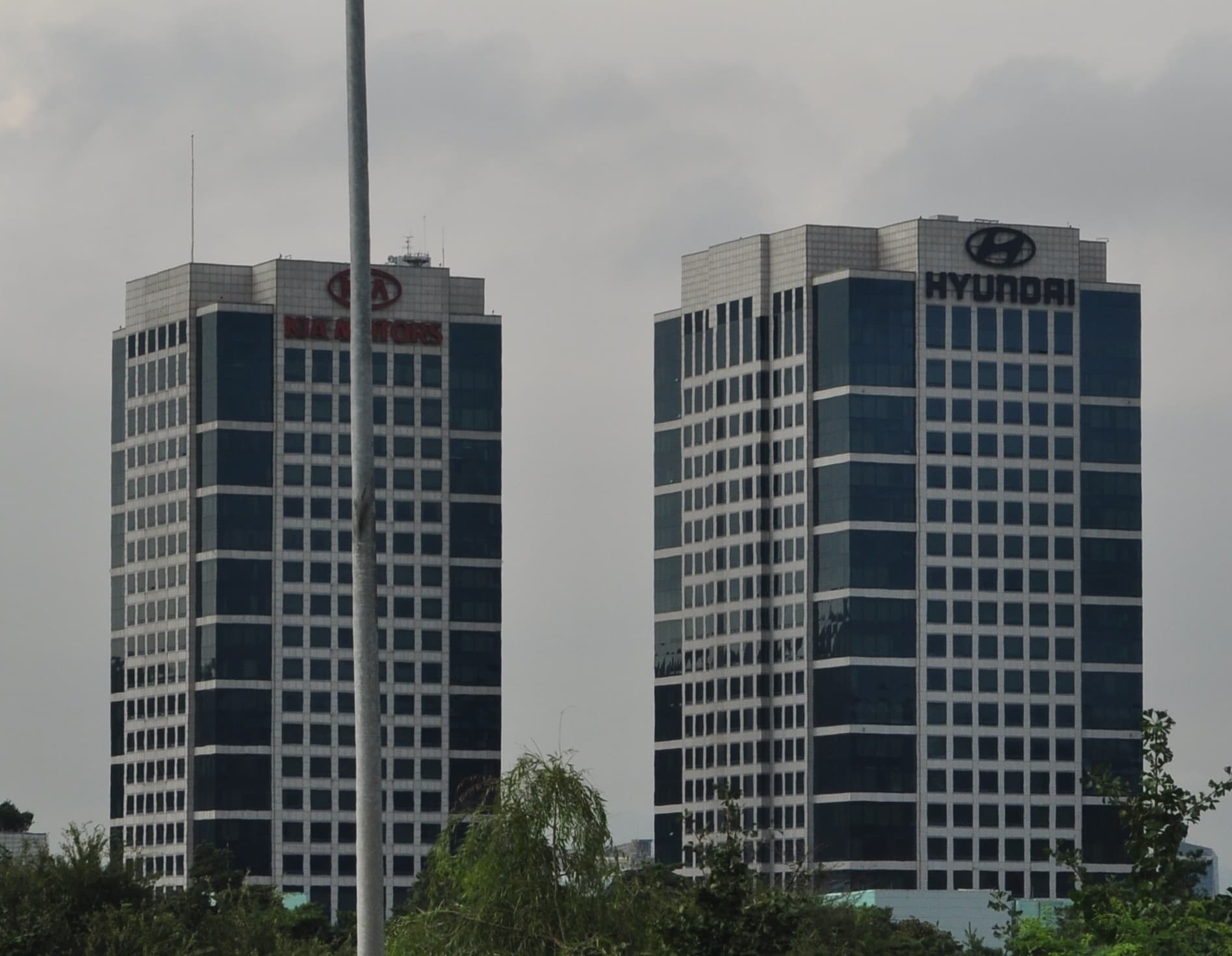
Image: Hyundai Motor Group Headquarters (Seoul) — Wikimedia Commons (CC BY-SA 3.0)