Tonight's Verdict: 5 Reasons Samsung Electronics Could See Its Second General Strike in 2 Years If NLRC Mediation Fails
The result of Samsung Electronics' second NLRC (National Labor Relations Commission) mediation between labor and management comes on March 3. If mediation is suspended, the 63,000-member joint bargaining unit will immediately proceed to a strike vote — potentially making the second general strike in two years a reality amid the semiconductor supercycle.
Today (March 3), the outcome of Samsung Electronics' second NLRC mediation session could hand the 63,000-member joint bargaining unit the legal right to strike. While the semiconductor supercycle has driven record-breaking results, the 50%-of-annual-salary cap on bonuses remains intact — and news that SK Hynix employees are receiving bonuses exceeding ₩100 million has poured fuel on the fire.
TL;DR
- Samsung Electronics' three-union joint bargaining unit declares 2026 wage and collective agreement negotiations collapsed (Feb. 19) → Files for NLRC mediation
- Today (March 3): Second NLRC mediation session — if no agreement is reached, a 'suspension of mediation' ruling is issued
- Suspension → Strike vote → If passed, the second general strike in 2 years becomes legally permitted
- Core issue: Abolition of the OPI (Outperformance Incentive) cap and transparency in the calculation method
- The Samsung Electronics chapter of the Samsung Group Cross-Enterprise Union is now Samsung Electronics' first single majority union (63,579 members as of Jan. 30)
The Facts — What Happened
Samsung Electronics' 2026 wage and collective agreement negotiations officially collapsed on February 19. The joint bargaining unit — comprising the National Samsung Electronics Union (NSEU), the Samsung Electronics chapter of the Samsung Group Cross-Enterprise Union, and Samsung Electronics Union Donghaeng — filed a labor dispute mediation request with the National Labor Relations Commission (NLRC). Following a first mediation session, the second mediation meeting is being held on March 3.
"Reaching an agreement in the current situation is difficult." — Woo Ha-gyeong, Senior Vice Chairman (Acting Chairman) of NSEU
Why It's Escalating — 5 Factors
1. The Bonus Gap with SK Hynix
SK Hynix reached a labor-management agreement in 2025 to completely abolish its bonus cap and committed to earmarking 10% of operating profit as the bonus pool. Among Samsung Electronics employees, a sense of deprivation has spread — "SK is giving over ₩100 million; why can't Samsung?"
2. Semiconductor Supercycle = Record-Breaking Results
Samsung Electronics' semiconductor (DS) division has been posting record results since 2025, driven by a memory market recovery and a surge in AI chip demand. The stronger the performance, the more the 'bonus cap' is perceived as unreasonable.
3. Cross-Enterprise Union = First Single Majority Union
The Samsung Electronics chapter of the Cross-Enterprise Union reached 63,579 members as of January 30, making it likely to hold majority union status. A majority union gains significantly greater negotiating leverage against management.
4. The Learning Curve from the August 2024 First General Strike
Samsung Electronics experienced its first-ever full strike in August 2024. Another general strike involving over 6,500 employees followed in January 2026. As the learning curve flattens, collective mobilization has grown stronger.
5. Pressure from the Pyeongtaek P4 Factory Completion Schedule
Samsung Electronics is running night and overtime operations to complete the Pyeongtaek P4 factory. A strike could directly threaten the factory's completion timeline and Samsung's ability to compete with Tesla and TSMC in the foundry business.
Context / Background
Samsung Electronics' OPI (Outperformance Incentive) system uses 20% of EVA (Economic Value Added) as its funding base, capped at a maximum of 50% of annual salary. The unions are demanding that this cap be abolished and replaced with a simpler, more transparent system based on operating profit. Management has offered limited concessions citing business stability, but the joint bargaining unit has rejected these proposals.
Reports indicate that the abolition of the OPI cap itself was virtually agreed upon during intensive talks, but disagreements remain on specifics such as transparency of the calculation basis, tiered payment ratios, and mandatory stock payment and lock-up restrictions for excess performance shares.
Outlook — How Far Could This Go?
| Scenario | Likelihood | Impact |
|---|---|---|
| Agreement at 2nd Mediation | Low | Strike crisis averted, share price stabilizes |
Checklist — Key Watchpoints for Investors and Stakeholders
Reference Links
- Money Today: Samsung Electronics strike risk amid chip boom? Bonus gap, 2nd mediation
- Hankyoreh: Remove the bonus cap — Samsung Electronics union wage talks collapse
- BusinessPost: Samsung Electronics union declares 2026 wage negotiations collapsed
- Daily Labor News: Bonus cap broken, but Samsung Electronics wage talks still murky
- Aju News: Is a second general strike on the horizon? Samsung Electronics labor-management in final NLRC mediation
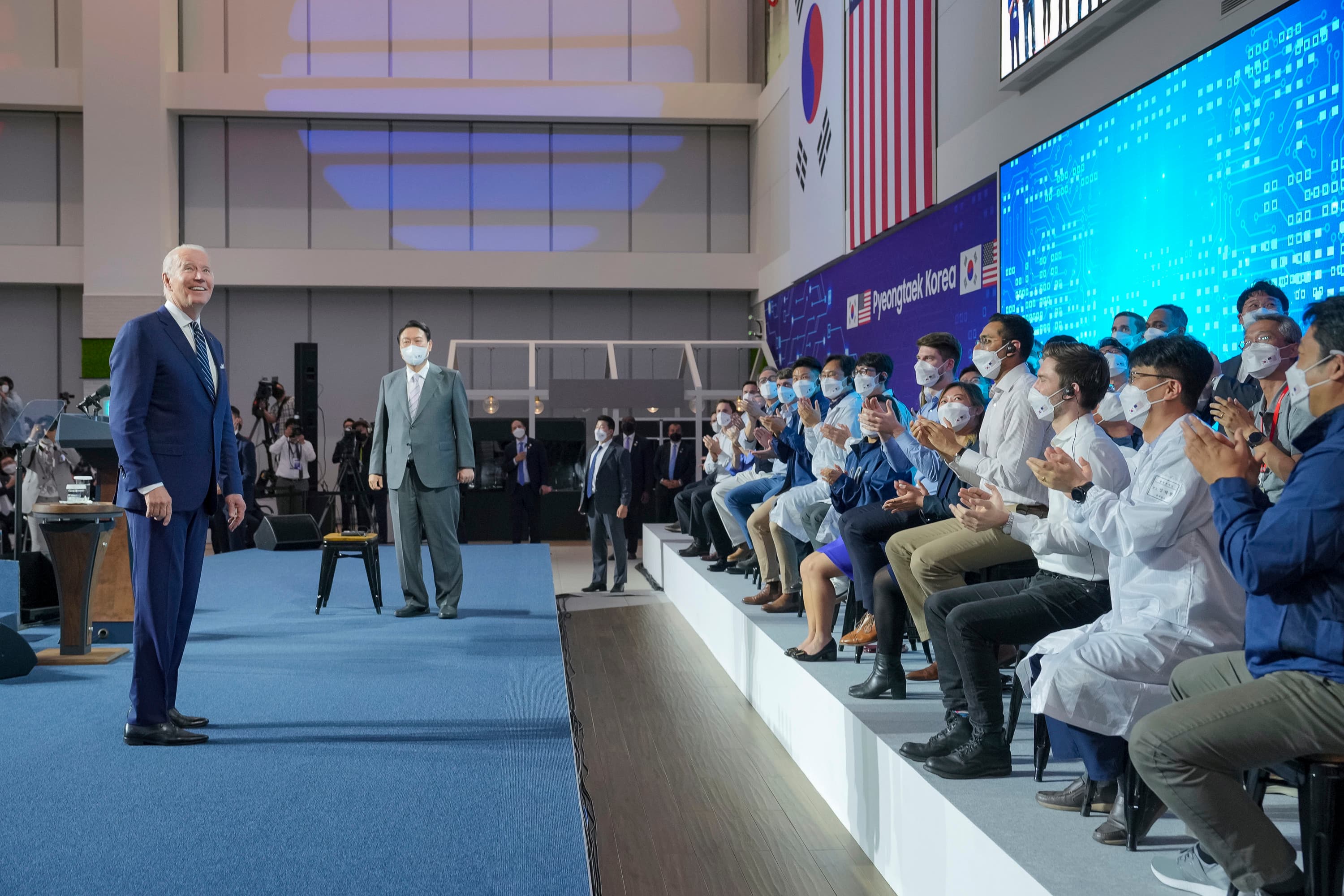
Image credit: Wikimedia Commons — President Biden visited the Samsung Electronics Pyeongtaek Campus (3) — Public Domain / Office of the President of the United States