The Semiconductor Report Card: 4 Signals Korea's 6th Consecutive BOK Rate Freeze and 2% Growth Forecast Upgrade Send to the 2026 Economy
The Bank of Korea held its benchmark interest rate at 2.50% for the sixth consecutive time on February 26, and raised its 2026 growth forecast from 1.8% to 2.0%. The AI semiconductor supercycle-driven export surge is the key driver, and Governor Lee Chang-yong publicly unveiled the dot-plot for the first time, signaling that rate changes are unlikely within the next 6 months.
Why This Matters Now
On February 26, 2026, the Bank of Korea (BOK) held its benchmark interest rate at 2.50% for the sixth consecutive time, while simultaneously raising its growth forecast for the year from 1.8% to 2.0%. This shattered the conventional equation of "rate freeze = pessimism." It also marks the first official declaration that the AI semiconductor supercycle is transforming the structural foundation of Korea's economy.
TL;DR
- BOK Monetary Policy Committee holds benchmark rate at 2.50% for the 6th consecutive meeting (since November 2025)
- 2026 GDP growth forecast upgraded 1.8% → 2.0% — reflecting semiconductor export surge
- Governor Lee Chang-yong: "Rate hike or cut within 6 months is unlikely" — first-ever dot-plot release
- Among 21 MPC members, 16 favor hold, 1 hike (2.75%), 4 cut (2.25%)
- KRW/USD exchange rate around 1,422; 3-year Treasury yield falls to 3.035%
1. The Facts: What Happened
The Bank of Korea's Monetary Policy Committee unanimously held the benchmark interest rate at the current 2.50% per annum at its regular meeting on February 26. This is the sixth consecutive hold, following five straight holds since the first rate cut in October last year.
Simultaneously, the BOK released a revised economic outlook, raising the 2026 real GDP growth rate from 1.8% (forecast in November 2025) to 2.0%, a 0.2 percentage point upgrade. Governor Lee Chang-yong cited "entry into a semiconductor supercycle driven by the AI boom" as the primary reason for the upward revision.
In a historic first for the BOK, this meeting also saw the release of a dot-plot — a method adopted from the U.S. Federal Reserve. Of the 21 MPC members and advisory members, 16 projected the benchmark rate would remain at 2.50% over the next six months, while 1 projected a hike to 2.75% and 4 projected a cut to 2.25%.
2. Why This Story Broke Through
① The symbolism of the growth upgrade: With 2025 growth stuck in the 1% range, a recovery to the 2% range is a powerful signal for both investors and the general public.
② The debut of the dot-plot: The dot-plot — appearing for the first time in Korea's monetary policy history — visualizes uncertainty around the interest rate path. The concentration of 16 members on "hold" implies no rate movement for the foreseeable future.
③ Governor Lee's imminent retirement: With Governor Lee Chang-yong set to retire in April, this is being interpreted as his "final message," drawing significant attention to the policy direction of the next governor.
④ Semiconductor export surprise: Exports for February 1–20 surged 47.3% year-on-year, significantly exceeding expectations.
3. Context & Background
After cutting the benchmark rate from 3.00% to 2.75% in October 2025, the BOK held rates at four consecutive meetings — November, December, January, and February 26 (the sixth hold overall). Three key risk factors underpin the decision to hold:
| Risk Factor | Current Status |
|---|---|
| Household Debt | Rising continuously amid concerns over a rebound in the real estate market |
| Exchange Rate | KRW/USD around 1,420 — "reassuring" level, but uncertainty persists |
| Inflation | Consumer prices near the 2% target, relatively stable |
Governor Lee stated: "Domestically, the factors driving KRW weakness have eased, but we are not yet at a point where concerns about exceeding 1,500 have disappeared."
4. Outlook: What Comes Next
Rate cut resumption likely in the second half: ANZ economist Crystal Tan assessed that "today's meeting provided no grounds to change the baseline scenario of holding the benchmark rate at 2.50% throughout 2026."
Risk of deepening semiconductor dependency: The semiconductor exports underpinning the growth upgrade are tied to the AI capital expenditure cycle, meaning they could drop sharply if global investment slows.
Policy continuity under the next governor: Whether the next governor will maintain the dot-plot tradition and accelerate the pace of rate cut resumption is the key variable for the second half of the year.
5. Checklist: What to Verify Now
Reference Links
- Reuters: S.Korea central bank holds rates, adopts dot-plot path (2026-02-26)
- Korea Times: BOK lifts 2026 growth forecast from 1.8% to 2% on strong chip exports
- Korea Herald: BOK raises S. Korea's 2026 growth forecast to 2%
- Bloomberg: BOK Holds Base Rate Steady as Economic Risks Roughly Balanced
Image Credit
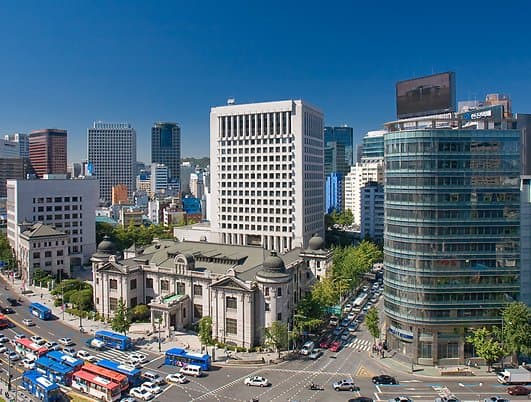
- Bank of Korea main office: Wikimedia Commons (Public Domain)