17 Years After 1,500 Won Falls: 5 Shocks the Won-Dollar Exchange Rate's Return to Financial Crisis Levels Sends to Korea's Economy and Households
The won-dollar exchange rate has broken through the 1,500 won level for the first time in 17 years since the 2009 global financial crisis. A surge in dollar demand following the outbreak of the Iran war and soaring energy import costs have combined to put Korea's entire economy on high alert.
One-Line Hook: The won-dollar exchange rate has breached 1,500 won for the first time in 17 years — this is not just a number; it is an alarm questioning the resilience of Korea's entire economy.
TL;DR
- On March 4, 2026, the won-dollar exchange rate surpassed 1,500 won intraday — the first time in 17 years since the 2009 global financial crisis.
- In the immediate aftermath of the U.S.–Israel airstrikes on Iran, global capital rushed into the dollar as a safe-haven asset.
- Bank of Korea Governor Lee Chang-yong postponed an overseas trip and convened an emergency market monitoring meeting.
- A sustained won rate in the 1,500 won range will send a chain of shocks through import prices, energy costs, and household purchasing power.
- Experts do not rule out the possibility of rates entering the 1,550–1,600 won range if the Iran war drags on.
📌 The Facts — What Happened
On March 4, 2026, the won-dollar exchange rate broke through 1,500 won intraday at the Seoul foreign exchange market. This marks the first time in approximately 17 years since the global financial crisis in March 2009.
On the same day, the Korean stock market (KOSPI) suffered its largest ever single-day decline of over 12%, as foreign investors panic-sold domestic equities en masse and rushed to buy dollars. Bank of Korea Governor Lee Chang-yong abruptly cancelled his scheduled overseas engagements and convened an emergency financial market monitoring meeting.
From March 5 to 7, the exchange rate has continued to fluctuate unstably, hovering between 1,460 and 1,500 won. As of March 7, the Korea Times is running the headline: "Korean won drops below 1,500 per dollar for first time since 2009 financial crisis."
🔥 Why It Rose This Far — Contributing Factors
1. Surge in Dollar Demand Triggered by the Iran War
Following the U.S.–Israel airstrikes on Iran (starting March 1), global capital rushed into the dollar as a safe-haven asset. While emerging market currencies broadly weakened, Korea — with an energy import dependency of 98% — was particularly vulnerable.
2. KOSPI's 12% Crash and Foreign Capital Flight
Foreign investors concentrated their selling of Korean equities and conversion to dollars in a short period. Amid the chaos of circuit breakers being triggered, pressure to sell the won and buy the dollar accelerated.
3. Rising Energy Import Costs on Hormuz Blockade Fears
After the IRGC declared control over the Strait of Hormuz, Korea faced structural pressure to spend more dollars to diversify its oil procurement routes.
4. Retreat of U.S. Fed Rate Cut Expectations
As the probability grew that the oil price spike from the Iran war would stoke U.S. inflation, expectations for the timing of Fed rate cuts were pushed back. Growing fears of a widening Korea-U.S. interest rate gap further deepened the won's weakness.
🌐 Context and Background
The 1,500 won mark carries a particularly powerful psychological meaning for Koreans. There have been two previous breaches:
- 1997–1998 IMF Foreign Exchange Crisis: The rate approached 2,000 won.
- 2008–2009 Global Financial Crisis: The rate surged to 1,597 won in March 2009.
In both cases, Korea's economy was in structural crisis. This time, foreign exchange reserves (approximately $410 billion) are far more robust and the ratio of short-term external debt is lower, so the prevailing view is that a repeat of the IMF crisis is unlikely. However, if the Iran war is prolonged, Korea could face a triple blow of a trade deficit, rising inflation, and shrinking domestic demand.
🔮 Outlook — How Long Will It Last?
| Scenario | Exchange Rate Outlook | Probability |
|---|---|---|
| Iran war ends early (4–6 weeks) | Return to 1,350–1,400 won range | Medium |
| War drags on (3+ months) | Sustained 1,500–1,550 won range | Medium–High |
| Hormuz blockade materializes | Possible entry into 1,600 won range | Low–Medium |
The Bank of Korea is conducting smoothing operations (foreign exchange intervention) to ease market volatility, but there are concerns that it has limits in countering structural dollar demand.
✅ Checklist — What to Do Right Now
🔗 References
- Exchange rate briefly breaks 1,500 won… First breach since the financial crisis 17 years ago — Daum
- Korean won drops below 1,500 per dollar for first time since 2009 financial crisis — Korea Times
- Exchange rate briefly breaks 1,500 won… Korea's economy on 'high alert' — KBS YouTube
- Iran: 'Mediation attempts underway'… International oil prices surge for consecutive days — Yonhap News TV
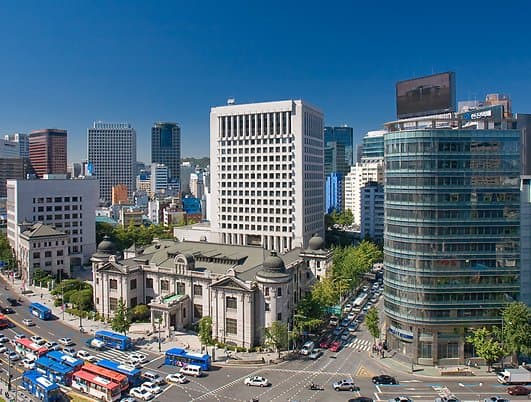
Image source: Bank of Korea Headquarters — Wikimedia Commons, Public Domain