Lowest in 30 Years: 5 Reasons China's NPC 2026 Cut Its GDP Target to 4.5–5% and the Shockwaves for Korea's Exports and Investment
China's 2026 National People's Congress set a GDP growth target of 4.5–5%, the first time the target has fallen below 5% since 1991. As an energy crisis sparked by the U.S.-Iran war, debt restructuring, and U.S.-China trade tensions compound one another, we analyze the ripple effects of a slowdown in Korea's largest trading partner on exports, semiconductors, and the battery industry.
Why you need to read this now: For the first time in 35 years, China has lowered its GDP growth target below 5%. This 'low-growth declaration' from Korea's largest trading partner — accounting for roughly 20% of Korean exports — is far more than a mere number change.
TL;DR
- China's 2026 NPC (March 5–12) announced a GDP growth target of 4.5–5% — the lowest since 1991
- Premier Li Qiang's government work report: first official acknowledgment of a "serious and complex domestic and international environment"
- The first year of the 15th Five-Year Plan (2026–2030) is set as the inaugural year of high-quality growth and a pivot to domestic demand
- Anti-corruption crackdown continues — 113 absent from opening ceremony, the most since Xi Jinping took power (excluding the COVID period)
- Structural restructuring pressure intensifying on Korea's exports to China, semiconductors, and battery industries
The Facts — What Happened
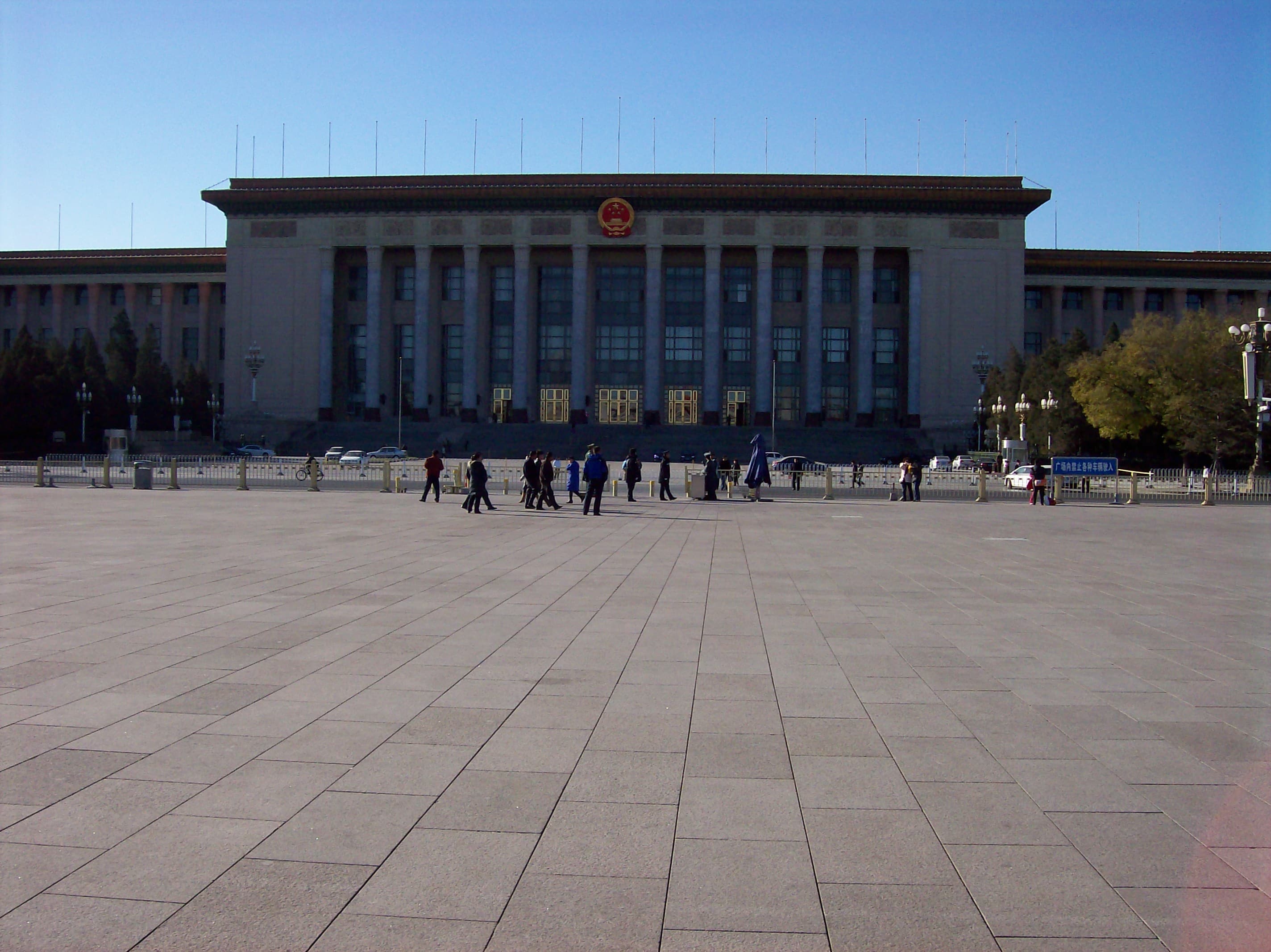
The 4th Session of the 14th National People's Congress opened on March 5, 2026 at the Great Hall of the People in Beijing. Of 2,765 delegates, 113 were absent — the highest absentee rate since the COVID lockdown (161 in 2022). Most absences are believed to be linked to ongoing anti-corruption investigations.
Premier Li Qiang presented a 2026 GDP growth target of 4.5–5% in the government work report. This is the first time China has officially set a target below 5% since 1991. The defense budget was increased 7.5% year-on-year, surpassing the equivalent of ₩400 trillion, reinforcing a message of resistance to U.S. hegemony.
The four core agenda items of this NPC session are:
- Review of the 15th Five-Year Plan (2026–2030) outline draft
- Deliberation on the 2026 budget and fiscal deficit target (approximately 4% of GDP)
- Legal revisions including the Environmental Code and the Law on Promoting Ethnic Unity and Progress
- Approval of work reports from the Supreme People's Court and Supreme People's Procuratorate
Why the World Is Watching — 5 Drivers
Reason 1: A Target Cut After 35 Years — Official Acknowledgment of Structural Transition
China maintained a target of 'around 5%' for three consecutive years starting in 2023. The new 4.5–5% range is not a simple adjustment — it officially marks the end of the export-driven high-growth model. Li Qiang stated: "High-quality development comes first; we will not chase numbers."
Reason 2: Energy Crisis Sparked by the U.S.-Iran War
With the Strait of Hormuz effectively blockaded, international oil prices have surged, dramatically increasing China's energy import costs. China relies on the Middle East for over 40% of its crude oil imports and has taken a direct hit. This is the backdrop for the NPC's prominent emphasis on "strengthening mediation with Iran."
Reason 3: Persistent Weak Domestic Demand and Real Estate Deleveraging
Consumer price inflation is hovering near zero while real estate debt restructuring remains unfinished. Capital Economics' criticism that effective policy tools to stimulate household consumption are absent has weighed on global investor sentiment.
Reason 4: Political Uncertainty From Anti-Corruption Purges
The removal of six officials — including former Central Military Commission members Zhang Youxia and Liu Zhenli — has already been formalized, while the whereabouts of Politburo member Ma Xingrui remain unclear. With 113 absent from the NPC opening ceremony — the most in Xi Jinping's 14-year rule — decision-making uncertainty is acting as a barrier to attracting foreign investment.
Reason 5: The 15th Five-Year Plan — A Blueprint for AI and Supply Chain Restructuring
This NPC session finalizes China's economic roadmap for the next five years (2026–2030). The core pillars are AI, semiconductor, and battery self-reliance; domestic market development; and an upgrade of the 'dual circulation' strategy. This is a signal that Korean companies must fundamentally reassess their business structures within China.
Context and Background
Since 2020, China has presented its GDP target as either a single figure or a narrow range each year. This range setting is interpreted as an intention to secure policy flexibility in the face of external uncertainty. Bloomberg, CNN, and The Guardian all reported it as "the lowest target in decades," and global markets are reading it as a signal of a decline in China's potential growth rate.
Outlook — 5 Ripple Effects on Korea's Economy
| Sector | Impact | Risk Level |
|---|---|---|
| Semiconductors (Memory) | Declining China-bound demand; accelerated domestic development of HBM alternatives | ⚠️ High |
| Batteries & EV Components | Slowdown in China's domestic EV demand → reduced demand for Korean materials | ⚠️ High |
| Petrochemicals | Lower operating rates at Chinese chemical plants → reduced naphtha demand | ⚠️ Medium |
| K-Consumer Goods (Cosmetics & Food) | Weakened consumer sentiment from domestic slump → premium demand hit | ⚠️ Medium |
| Construction & Infrastructure Contracts | Expanded infrastructure investment in 15th Five-Year Plan → export opportunities for equipment | 🟢 Opportunity |
Checklist — What to Verify Now
References
- China NPC Opens: GDP Target of 4.5–5% Announced — Yonhap News
- China Sets Lowest GDP Target in Decades — CNN
- Two Sessions 2026 Key Takeaways — China Briefing
- 113 Absent from NPC Opening Ceremony — News1
- China's Economic Roadmap 2026 — Capital Economics
Image Source
- Beijing Great Hall of the People: Wikimedia Commons (CC BY-SA 3.0)